Printable Weider Ultimate Body Works Chart Download
| "The Weight" | ||||
|---|---|---|---|---|
 | ||||
| Single by the Ring | ||||
| from the album Music from Large Pink | ||||
| B-side | "I Shall Be Released" | |||
| Released | August 8, 1968 (1968-08-08) | |||
| Recorded | January 1968 | |||
| Studio | A&R Recorders (studio A), New York City | |||
| Genre |
| |||
| Length | 4:34 | |||
| Label | Capitol | |||
| Songwriter(s) | Robbie Robertson | |||
| Producer(s) | John Simon | |||
| The Band singles chronology | ||||
| ||||
| Sound sample | ||||
| ||||
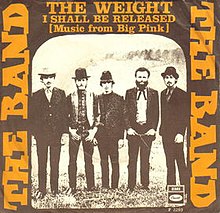
"The Weight" is an original song by the Canadian-American group the Band that was released as a unmarried in 1968 and on the group's debut album Music from Big Pink. It was their kickoff release under this name, after their previous releases every bit Canadian Squires and Levon and the Hawks. Written by Ring member Robbie Robertson, the song is near a visitor'due south experiences in a town mentioned in the lyric's first line equally Nazareth. "The Weight" has significantly influenced American popular music, having been listed as No. 41 on Rolling Stone 's 500 Greatest Songs of All Time published in 2004.[3] Pitchfork Media named it the 13th all-time vocal of the Sixties,[four] and the Rock and Roll Hall of Fame named it one of the 500 Songs that Shaped Stone and Scroll.[5] PBS, which broadcast performances of the vocal in Ramble at the Ryman (2011), Austin Urban center Limits (2012),[6] and Quick Hits (2012), describes it as "a masterpiece of Biblical allusions, enigmatic lines and iconic characters" and notes its enduring popularity equally "an essential part of the American songbook."[7]
"The Weight" is one of the Band'due south all-time known songs, gaining considerable anthology-oriented rock airplay even though it was not a significant hit single for the group in the The states, peaking at only No. 63.[eight] Later on information technology was released, the tape debuted only half dozen days after on KHJ's "'Boss thirty' records"[9] and peaked at No. iii there iii weeks afterward. The Band'southward recording too fared well in Canada and the Uk – in those countries, the single was a top 40 hit, peaking at No. 35 in Canada and No. 21 in the U.k. in 1968. Cash Box chosen it a "powerhouse performance."[10]
The song had three cover releases in 1968 and 1969 with arrangements that appealed to a diversity of music audiences. Aretha Franklin'due south 1969 soul music organisation was included in her This Girl'southward in Love with You anthology, which peaked in the U.S. at No. 19 on the Hot 100 and No. 3 on the soul chart and also peaked in Canada at No. 12.[11] Jackie DeShannon's 1968 pop arrangement, debuting on the Hot 100 one calendar week before The Ring's, peaked at No. 55 in the U.s.a. and No. 35 in Canada. A joint single rhythm and dejection arrangement, released by Diana Ross & the Supremes and The Temptations in 1969, hit No. 46 in the US and No. 36 in Canada. The Ring's and Jackie DeShannon'southward versions never mentioned the title. The Ring'due south version—in its original release, non counting sure other releases later—credits the group'southward individual members—Robbie Robertson, Rick Danko, Richard Manuel, Garth Hudson and Levon Helm—on the tape label, rather than the Band as a single entity. The group had signed to Capitol equally the Krackers and the name "the Band" had nevertheless to be arrived at when Music from Big Pink was issued. The grouping was not identified as "the Band" until their second album.
Limerick [edit]
Inspiration and influences [edit]
The inspiration for and influences affecting the limerick of "The Weight" came from the music of the American S, the life experiences of ring members, particularly Levon Helm, and movies of filmmakers Ingmar Bergman and Luis Buñuel.[12] At that place are also hints of influences involving drug deals and the band's relationship with known drug dealer Cathy Smith.[xiii]
The original members of the Band performed "The Weight" as an American Southern folk song with country music (vocals, guitars and drums) and gospel music (piano and organ) elements. The lyrics,[14] written in the first-person, are about a traveler's experiences arriving, visiting, and departing a town chosen Nazareth. According to Robertson, this is based on Nazareth, Pennsylvania, because it was the home of Martin Guitars. He wrote the guitar parts on a 1951 Martin D-28.[12] The singers, led by Captain, vocalize the traveler's encounters with people in the town from the perspective of a Bible Belt American Southerner,[fifteen] similar Captain himself, a native of rural Arkansas.
The colorful characters in "The Weight" were based on real people that members of the Band knew, as Levon Helm explained in his autobiography, This Wheel's on Burn down. In item, "immature Anna Lee" mentioned in the tertiary verse is Helm's longtime friend Anna Lee Amsden,[16] and, according to her, "Carmen" was from Captain's hometown, Turkey Scratch, Arkansas.[17] "Crazy Chester" was an eccentric resident of Fayetteville, Arkansas, who carried a cap gun. Ronnie Hawkins would tell him to "keep the peace" at his Rockwood Lodge when Chester arrived.
According to Robertson, "The Weight" was inspired by the movies of Spanish filmmaker Luis Buñuel. Buñuel'south films are known for their surreal imagery and criticism of organized faith, particularly Catholicism. The song's lyrics and music invoke vivid imagery, the chief character's perspective is influenced past the Bible, and the episodic story was inspired by the predicaments Buñuel'due south film characters faced that undermined their goals for maintaining or improving their moral character. Of this, Robertson in one case stated:
(Buñuel) did and so many films on the impossibility of sainthood. People trying to be expert in Viridiana and Nazarín, people trying to do their thing. In "The Weight" it's the same thing. People like Buñuel would make films that had these religious connotations to them just it wasn't necessarily a religious meaning. In Buñuel there were these people trying to be expert and information technology's incommunicable to exist good. In "The Weight" it was this very simple thing. Someone says, "Listen, would y'all do me this favour? When yous get there will you lot say 'hi' to somebody or will y'all give somebody this or will you option up one of these for me? Oh? Yous're going to Nazareth, that's where the Martin guitar factory is. Do me a favour when you're at that place." This is what it's all near. So the guy goes and one thing leads to another and information technology'due south similar "Holy shit, what's this turned into? I've just come up here to say 'hello' for somebody and I've got myself in this incredible predicament." It was very Buñuelish to me at the fourth dimension.[18]
This is besides related in Robertson'due south 2016 autobiography, Testimony.
Personnel [edit]
Credits are adapted from the liner notes of A Musical History.[19]
- Levon Helm – lead and harmony vocals, drums
- Rick Danko – co-atomic number 82 and harmony vocals, bass guitar
- Richard Manuel – Hammond organ, harmony vocals
- Garth Hudson – piano
- Robbie Robertson – acoustic guitar
Songwriting credit dispute [edit]
The songwriting credit to Robbie Robertson for "The Weight", similar credit for many of the songs performed by the Band, was disputed years later by Levon Helm. Helm insisted that the composition of the lyrics and the music was collaborative, declaring that each band member fabricated a substantial contribution. In an interview, Helm credited Robertson with sixty per centum of the lyrics, Danko and Manuel with 20 percent each of the lyrics, much of the music credit to Garth Hudson, and a small credit to himself for lyrics.[twenty]
Versions by other artists [edit]
- The Staple Singers covered "The Weight" for their 1968 album Soul Folk in Action, which was described as 1 of two album highlights in a review.[21] The group later collaborated with the Band to record a joint performance for the 1976 film The Last Waltz.[22]
- A 1969 version by Smith is used on the Easy Rider flick soundtrack.[23] The Band'southward record characterization Capitol did not allow the Ring'south recording to be used on the soundtrack anthology, so it "was replaced by a virtually-copy recorded past Dunhill [the soundtrack album characterization] act Smith".[23]
- In 1969, Diana Ross & the Supremes and the Temptations recorded a version of "The Weight" for their album Together. Released as a unmarried, it appeared on several charts, including numbers 46 on Billboard magazine'due south Hot 100 and 33 on its Best Selling Soul Singles charts.[24] [a]
- In 2006, Canadian country music creative person Aaron Pritchett covered "The Weight" on his album Large Wheel. It was released as a single and reached number six on the Billboard Canada Country nautical chart,[29] and number 90 on the Canadian Hot 100.[30]
- In 2019, Playing for Alter collaborated with Robbie Robertson and Ringo Starr to record a version of the song celebrating its fiftieth anniversary.[31]
References [edit]
- ^ Fontenot, Robert. "What is Country Rock?". ThoughtCo. About.com. Retrieved March 12, 2017.
- ^ Bruce Pollock (August 26, 2005). Stone Song Index: The 7500 Almost Important Songs for the Rock and Curl Era. Routledge. p. 398. ISBN9780415970730.
- ^ "The RS 500 Greatest Songs of All Time". RollingStone.com. Archived from the original on April 16, 2007. Retrieved 2007-06-02 .
- ^ "The 200 Greatest Songs of the Sixties". Pitchfork.com. August 18, 2006. Retrieved 2011-05-05 .
- ^ "InfoPlease Annual". Infoplease.com. Retrieved 2011-05-05 .
- ^ Leahey, Andrew (2012-xi-08). "Watch 'The Weight' From Austin City Limits' Americana Awards Episode". American Songwriter. Retrieved 2016-10-02 .
- ^ "Archived copy". Archived from the original on 2012-04-13. Retrieved 2013-01-06 .
{{cite web}}: CS1 maint: archived copy as title (link) - ^ Joel Whitburn'southward Top Popular Singles 8th edition
- ^ "KHJ's 'Dominate xxx' Records In Southern California! Official Result No. 163". KHJ. 1968-08-14. Retrieved 2019-08-29 .
- ^ "CashBox Record Reviews" (PDF). Cash Box. Baronial 17, 1968. p. 18. Retrieved 2022-01-12 .
- ^ Whitburn, Joel (2004). Meridian R&B/Hip-Hop Singles: 1942–2004. Tape Research. p. 215.
- ^ a b Myers, Marc (November 29, 2016). " 'The Weight' by the Band'southward Robbie Robertson". The Wall Street Journal.
- ^ Viney, Peter. "The Weight". The Band. Jan Høiberg. Retrieved 21 September 2020.
- ^ "The Weight". Theband.hiof.no . Retrieved 2016-10-02 .
- ^ Margolis, Lynne (2012-08-thirty). "No Fake Basic: The Legacy of Levon Helm « Folio 2 of 3 « American Songwriter". Americansongwriter.com . Retrieved 2016-10-02 .
- ^ "Archived re-create". Archived from the original on 2013-07-29. Retrieved 2013-01-26 .
{{cite web}}: CS1 maint: archived copy as title (link) - ^ "Levon Helm and The Ring: a rock parable of fame, betrayal, and redemption". CSMonitor.com. 2012-04-20. Retrieved 2016-10-02 .
- ^ "History of The Band: The Debut Album". Theband.hiof.no. 1991-07-26. Retrieved 2011-05-05 .
- ^ The Ring: A Musical History (CD). The Band. Capitol Records. 2005. 72435-77409-0-6 CCAP77409-vi.
{{cite AV media notes}}: CS1 maint: others in cite AV media (notes) (link) - ^ Getlen, Larry (2012-04-19). "Levon Helm, RIP | Larry Getlen'due south Random Thoughts". Larrygetlen.com. Archived from the original on 2017-02-25. Retrieved 2016-ten-02 .
- ^ Gottlieb, Bob. "The Staple Singers: Soul Folk in Action – Review". AllMusic . Retrieved September 27, 2021.
- ^ Deming, Marking. "The Ring: The Last Flit – Review". AllMusic . Retrieved September 27, 2021.
- ^ a b Ruhlmann, William. "Various Creative person: Easy Rider [Music from the Soundtrack] - Review". AllMusic . Retrieved September 23, 2021.
- ^ Whitburn, Joel (1988). "The Supremes". Peak R&B Singles 1942–1988. Menomonee Falls, Wisconsin: Record Research. p. 396. ISBN0-89820-068-7.
- ^ "RPM 100". RPM. No. 6093. p. 5 – via Bac-lac.gc.ca.
- ^ "Cash BOX Top 100 Singles". Cashbox. Oct 4, 1969. Retrieved Dec 31, 2020.
- ^ "100 TOP POPS: Week of September 27, 1969" (PDF). Record Earth. September 27, 1969. Retrieved January 29, 2021 – via Worldradiohistory.com.
- ^ "Top fifty R&B: Week of October 11, 1969" (PDF). Record Globe. Oct 11, 1969. p. 41. Retrieved Jan 29, 2021 – via Worldradiohistory.com.
- ^ "Aaron Pritchett Chart History (Canada Country)". Billboard . Retrieved July 9, 2021.
- ^ "Aaron Pritchett Chart History (Canadian Hot 100)". Billboard . Retrieved July 9, 2021.
- ^ "The Weight, Featuring Ringo Starr and Robbie Robertson, Playing For Change, Song Around The Globe". Archived from the original on 2021-12-12. Retrieved October 1, 2021.
Footnotes [edit]
- ^ Also reached No. 36 in Canada,[25] No. 39 on U.S. Cashbox Top 100,[26] No. 37 on U.South. Record Earth 100 Top Pops,[27] and No. 21 on U.S. Record World Top fifty R&B.[28]
DOWNLOAD HERE
Posted by: webbsudight64.blogspot.com


0 Comments